
Nyaya Health Nepal Custom DHIS2 Project
Project Specs
- Category: Projects
- Published: July 22, 2026
Nyaya Health Nepal Custom DHIS2 Platform – Organizational Data Management, Monitoring & Analytics System
Project Overview
The Nyaya Health Nepal Custom DHIS2 Platform is an enterprise-level data management and analytics system developed to support the organization’s internal program monitoring, operational reporting, and evidence-based decision-making. Built using the open-source District Health Information Software 2 (DHIS2) platform, the system was extensively customized to meet Nyaya Health Nepal’s organizational requirements for collecting, managing, analyzing, and visualizing data from multiple health and community programs.
Unlike traditional DHIS2 implementations used for government Health Management Information Systems (HMIS), this project was specifically designed as an organizational Monitoring, Evaluation, Accountability, and Learning (MEAL) platform. It enables Nyaya Health Nepal to collect standardized program data from projects operating across different districts and provinces, monitor key performance indicators, generate real-time dashboards, and prepare high-quality reports for organizational leadership, government stakeholders, and international development partners.
As the Senior DevOps Officer and Digital Systems Engineer, I was responsible for the complete infrastructure design, deployment, customization, security implementation, performance optimization, and long-term maintenance of the platform. My responsibilities covered Linux server administration, Docker deployment, PostgreSQL database management, automation, monitoring, backup strategies, and continuous system improvement.
The platform centralizes information from multiple projects into a single secure repository, eliminating fragmented spreadsheets and manual reporting processes. Program managers can now monitor project progress, compare indicators across locations, evaluate performance trends, and generate visual reports without requiring extensive manual data processing.
This project demonstrates my expertise in enterprise system deployment, DHIS2 customization, DevOps, database administration, cloud infrastructure, and digital transformation within the nonprofit and global health sectors.
Project Background
Nyaya Health Nepal manages numerous healthcare, digital health, community health, research, training, and development projects across Nepal. Each project generates significant volumes of operational and monitoring data that must be collected, verified, analyzed, and reported to organizational leadership and funding agencies.
Historically, much of this information was maintained using spreadsheets and manually compiled reports. This approach made data consolidation time-consuming, increased the risk of inconsistencies, and limited the organization’s ability to perform timely analysis.
To address these challenges, Nyaya Health Nepal decided to implement a centralized data management platform capable of supporting organization-wide monitoring and evaluation activities. The objective was to create a flexible system where different projects could define their own indicators, forms, datasets, and reporting structures while maintaining a common platform for data governance and analytics.
The result was a customized DHIS2 implementation that serves as the organization’s internal monitoring and reporting system, providing accurate, timely, and accessible information for strategic planning and donor reporting.
Project Objectives
The primary objectives of the project included:
- Build a centralized organizational data repository.
- Standardize data collection across multiple projects.
- Improve data quality and consistency.
- Monitor project performance through configurable indicators.
- Develop interactive dashboards for program managers.
- Generate donor and organizational reports efficiently.
- Support Monitoring, Evaluation, Accountability, and Learning (MEAL) activities.
- Reduce reliance on spreadsheets and manual reporting.
- Enable evidence-based strategic planning.
- Build a scalable and secure data management platform.
My Role
As the technical lead responsible for infrastructure and platform management, I handled the complete deployment and operational lifecycle of the system.
My responsibilities included:
- Requirement analysis with program teams.
- DHIS2 installation and customization.
- Linux server administration.
- Docker container deployment.
- PostgreSQL database administration.
- Metadata configuration.
- User and role management.
- Dashboard development.
- Custom data collection forms.
- Performance tuning.
- Backup automation.
- Security implementation.
- Monitoring and logging.
- Disaster recovery planning.
- System upgrades and maintenance.
- Technical documentation.
- User training and technical support.
Technologies Used
Core Platform
- DHIS2
- PostgreSQL
Infrastructure
- Linux (Ubuntu)
- Docker
- Docker Compose
- Nginx
- Apache
DevOps
- Git
- Shell Scripting
- Jenkins
- GitHub Actions
Monitoring
- Prometheus
- Grafana
- Loki
- Zabbix
Security
- SSL/TLS
- Firewall Configuration
- Automated Backup
- Access Control
Key Features
The customized platform includes numerous features tailored to organizational monitoring and reporting needs.
Major features include:
- Custom Data Collection Forms
- Program-Based Data Management
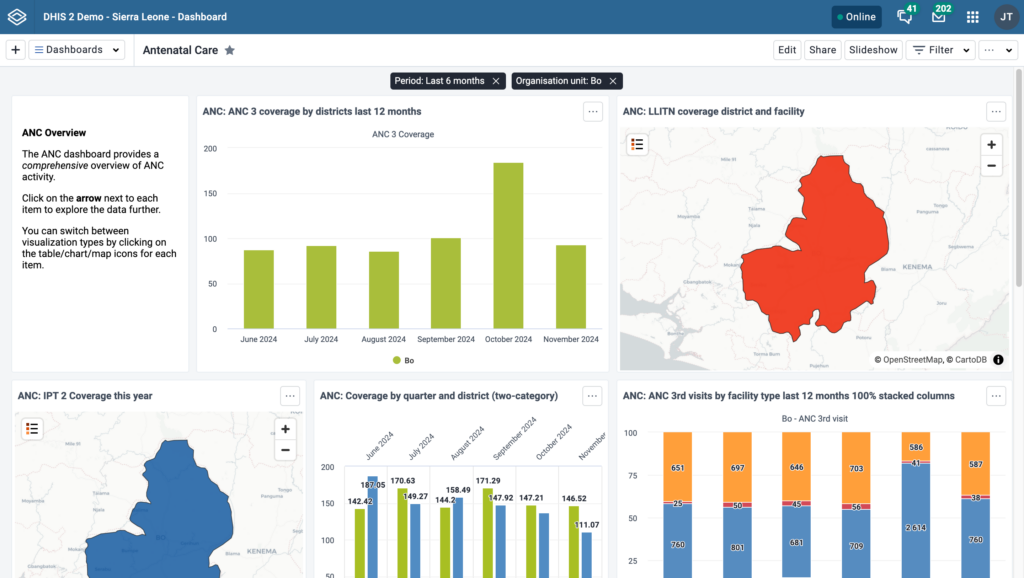
- Project Monitoring Dashboard
- KPI Tracking
- Configurable Indicators
- Interactive Charts and Graphs
- Organizational Reporting
- Donor Reporting Dashboard
- Geographic Data Visualization
- Data Validation Rules
- User Role Management
- Audit Logs
- Dataset Management
- Metadata Configuration
- Automated Reporting
- Data Export (Excel, CSV, PDF)
- Real-Time Analytics
- Historical Trend Analysis
- Performance Monitoring
- Multi-Project Data Management
System Architecture
The platform follows a centralized architecture where project teams submit standardized data through secure web-based forms. Information from multiple projects is stored within a centralized PostgreSQL database and organized according to project structure, reporting periods, geographical locations, and program indicators.
The platform provides configurable dashboards that allow management teams to monitor progress in real time. Authorized users can analyze trends, compare project performance, and generate reports for quarterly reviews, annual reports, donor submissions, and strategic planning.
The modular design enables new projects, indicators, and reporting frameworks to be added without requiring changes to the underlying infrastructure.
Performance Optimization
To ensure responsive performance while managing large datasets, extensive optimization techniques were implemented throughout the platform. Database indexing, optimized SQL queries, server tuning, and caching strategies significantly improved dashboard responsiveness and report generation times.
Docker-based deployment simplified application management and ensured consistent environments across development, testing, and production systems. Continuous monitoring helped identify performance bottlenecks before they affected users.
Routine maintenance and database optimization ensured the platform remained stable and responsive as organizational data continued to grow.
Security Implementation
Because the platform stores confidential organizational and project information, security was incorporated into every stage of implementation.
Role-based access control ensures users can access only the projects and data relevant to their responsibilities. HTTPS encryption protects communications between users and the platform, while automated backups safeguard organizational information against accidental loss.
Additional security measures included firewall configuration, server hardening, audit logging, password policies, regular software updates, and continuous monitoring to maintain platform reliability and protect sensitive program data.
Challenges
One of the primary challenges was designing a flexible data model capable of supporting multiple projects with different indicators, reporting frequencies, and data collection methodologies. Each program required unique forms and reporting structures while still operating within a unified platform.
Another challenge involved ensuring data quality across geographically distributed teams. Standardized metadata, validation rules, and user training helped improve consistency and reduce reporting errors.
Scalability was also a major consideration. The system needed to support new projects, increasing data volumes, and evolving reporting requirements without affecting performance. Through modular configuration, optimized infrastructure, and continuous monitoring, the platform successfully met these requirements.
Results and Impact
The implementation of the Nyaya Health Nepal Custom DHIS2 Platform significantly improved organizational data management and reporting capabilities. Program teams now collect and manage information using standardized digital tools rather than disconnected spreadsheets, improving data consistency and reducing reporting time.
Interactive dashboards provide management with real-time visibility into project performance, enabling faster identification of trends, operational challenges, and program achievements. The platform has also streamlined donor reporting by providing reliable, standardized data that can be quickly transformed into evidence-based reports and visualizations.
The centralized system supports informed decision-making at all organizational levels, strengthens accountability, and improves the efficiency of monitoring and evaluation activities. By replacing fragmented reporting processes with a unified digital platform, the organization has enhanced collaboration across programs while building a scalable foundation for future growth.
Conclusion
The Nyaya Health Nepal Custom DHIS2 Platform is one of the most significant enterprise systems I have implemented, showcasing my expertise in DHIS2 customization, DevOps, Linux server administration, database management, and enterprise data platforms.
By delivering a secure, scalable, and highly configurable monitoring and analytics solution, I helped Nyaya Health Nepal strengthen its organizational data management, improve program monitoring, simplify donor reporting, and support evidence-based decision-making. This project highlights my ability to transform complex organizational requirements into reliable digital solutions that improve operational efficiency and maximize the value of organizational data.